

A burning permit grants the individual holder the right to burn small amounts of dry leaves, plant clippings, brush, and clean untreated-unpainted wood if weather conditions do not pose a fire hazard.
An online burning permit is a convenient way to get your permit. You can activate it through your online account or by phone as often as needed (if conditions are safe to burn). It costs $5.00 (transaction fee) and is good for the calendar year.
Most counties allow online burning permits. Check the Burning permit by county webpage to see if your county participates.
To purchase an online burning permit, you'll need the following:
- Credit/Debit card (Mastercard or Visa)
- A valid email address
- A printer or smartphone to show proof of the permit
Purchase burning permit online
A written burning permit can be obtained through any DNR Forestry Office or an active fire warden at no cost. It is good for up to three continuous days, as listed on your permit. You can activate your written permit by phone (if conditions are safe to burn).
Note: while DNR issues statewide regulations, local permits or more stringent regulations may apply if you live within a municipality that controls the open burning
Current Burning Permit Restrictions

Map legend
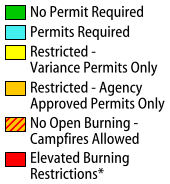
*Elevated Burning Restrictions – No open burning and additional restrictions as needed based on fire danger.
- When do I need a burning permit?
You need an open burning permit when:
- When the fire is more than 3 feet high and 3 feet in diameter.
- When the ground is not completely covered by a minimum of 3 inches of snow.
- When the fire is not contained in either an approved burner or in a cooking or heating device such as charcoal grill or camp stove.
- Where county or other local jurisdiction requires a burning permit year round or for all sizes of fires.
- How do I activate my burning permit?
You may activate your permit in two ways:
- Visit mndnr.gov/burningpermits
- You can also activate it by calling 1- 866-533-2876 and follow the instructions in the pre-recorded message.
- Why do you have to activate the permit daily before burning?
When the permit is activated, it shows on a map. The map is viewed by local dispatch offices, law enforcement and fire departments. To provide a clear map for these emergency managers, the map is reset every day at 8:00 a.m., so they know who is actively burning that day.
- When is a permit not needed?
A permit is not needed:
- for a "campfire"—a fire set for cooking, warming, or ceremonial purposes, which is not more than 3 feet in diameter by 3 feet high, and has had the ground 5 feet from the base of the fire cleared of all combustible material
- when the ground is snow-covered — by definition, when there is a continuous unbroken cover of snow 3 inches deep or more surrounding the immediate area of the fire, sufficient to keep the fire from spreading
- for a fire contained in a charcoal grill, camp stove, or other device designed for cooking or heating
- for a fire in an approved burner, and there is no combustible material within 5 feet of the base of the burner, and it is in use between the 6:00 p.m. and 8:00 a.m.
- What can I burn with a permit or in an approved burner?
You may burn vegetative material, such as grass, leaves, brush, and untreated lumber. More information on approved barrels.
- What materials cannot be burned?
You may not burn:
- hazardous wastes
- industrial solid waste
- demolition debris of commercial or institutional structures (farm buildings are not considered commercial structures)
- salvage operations
- motor vehicles
- oils
- rubber
- plastics
- chemically treated materials
- other materials which produce excessive or noxious smoke, such as tires, railroad ties, chemically treated lumber, composite board, drywall, wiring, paint, or paint filters
- garbage, defined as discarded material resulting from the handling, processing, storage, preparation, serving, or consumption of food.
- What if I want to burn a structure?
If you'd like to burn a structure, contact a DNR Forestry Officer.
- What are burning permit restrictions?
- Burning permits are not issued in fire-prone portions of the state in the spring when fire danger is traditionally high. A variance to permit open burning, however, may be obtained for special circumstances such as prescribed fire projects, approved agricultural practices, construction projects, or economic hardship. Variances may only be issued by DNR Forestry personnel. Dates of the restrictions are posted on this website each spring.
- These spring restrictions only regulate fires that require a permit. Recreational campfires are still allowed under annual spring restrictions.
- What are spring burning restrictions?
- Beginning in 2001 the DNR instituted spring burning permit restrictions in the fire prone portions of the state each spring. During this period of traditionally high fire danger, burning permits are not issued. Dates of the restrictions are posted on the DNR Web site each spring.
- Restricting the issuing of burning permits is a not a "burning ban." A burning ban stops all open burning, whether or not regulated by permit.
- Recreational campfires are still permissible under burning permit restrictions, but not under a burning ban.
- How are the dates for spring restrictions determined?
Restrictions are determined based on the availability and condition of fine fuels such as standing dead vegetation in fields, swamps, and other open areas that can be totally wet but when conditions change can dry and burn in a matter of hours. These fine fuels play a role in most fires responded to each year because when dry they ignite easily and can spread fire quickly. Once restrictions are established in an area, they remain in place until green-up occurs and fire danger is drastically reduced.
- What is a burning ban?
A burning ban is a restriction issued for a specified part of the state under extremely dry conditions in which existing burning permits are canceled and new permits not issued. Burning in approved burners, recreational fires, and even smoking outdoors may be prohibited, depending on the fire danger. This action is generally taken when fire risk becomes extreme across a broad area of the state. A burning ban is used only in the most severe conditions and is more restrictive.
- What is a special permit?
Special permits are authorized by a DNR Forestry Officer and are required for:
- Burning of structures by fire department for live fire training purposes
- Permanent sites for the burning of trees and brush
- What is a variance permit?
A variance permit, however, may be obtained for special circumstances such as:
- prescribed fire projects
- approved agricultural practices, if an economic hardship exists
- construction projects, if an economic hardship exists
- Grass fires greater 1 acre
- Brush piles greater than 20' x 20' x 20'
- Variance permits may only be issued by individuals designated to do so by the DNR Commissioner
- How do I report a fire?
- Report any suspected unauthorized fires by calling 911. (If 911 is not available in your area, your local DNR Forestry office can provide you with the numbers to call; call collect if necessary.) If in doubt, report a fire. An early report helps keep fires small.
- Detailed information is extremely important when reporting a fire. Please provide:
- your name and phone number so you can be contacted for further information if necessary
- location of the fire by street address or section, township, and range (preferred) or directions and distances from known roads or landmarks
- information on whether any structures or other improvements are threatened
- the approximate size of the fire
- the type of fuels the fire is burning and the type of fuels it is approaching
- the type of terrain and access into the fire
- the time the fire started, as well as who started it, if known
- information on whether anyone is working on the fire.